What a Ceiling Water Stain Really Means
That brown ring on your ceiling is rarely just a stain. Here's what a ceiling water stain means, how to trace it to the roof, and when to call for help in Baytown.
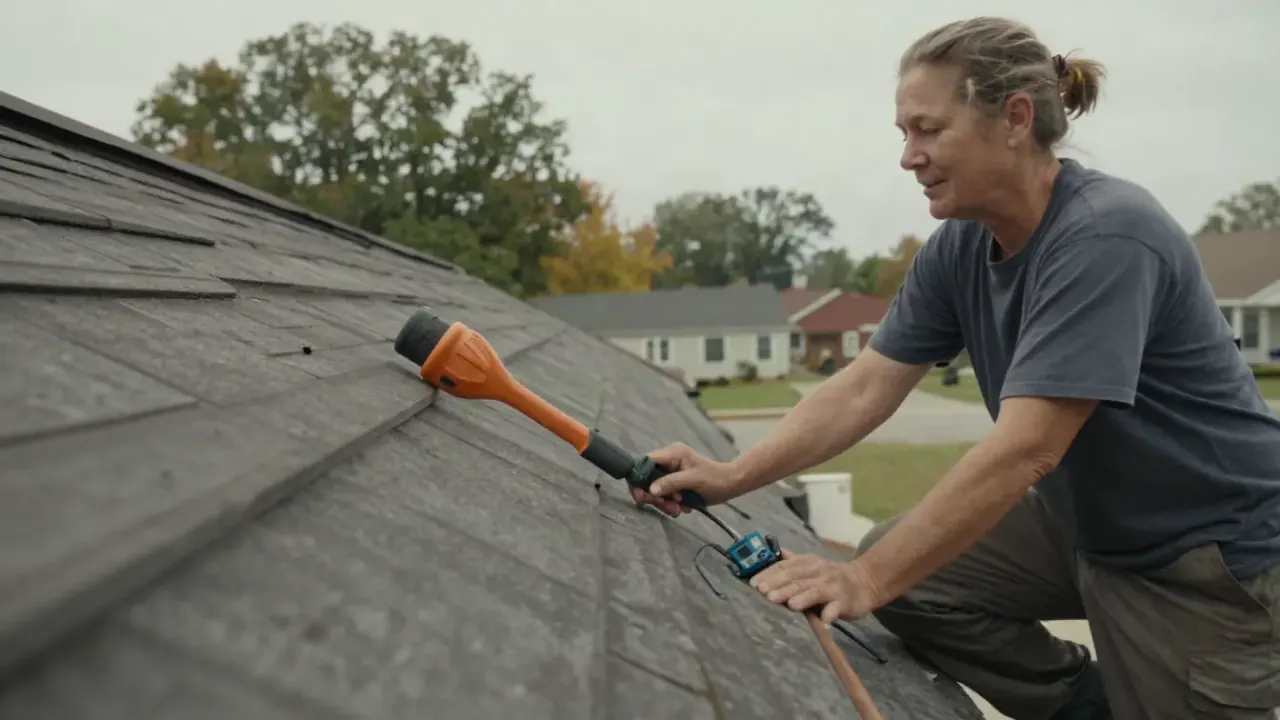
A ceiling water stain almost always means water is actively getting into your attic or ceiling cavity from above, and the brown or yellow ring you see is the dried mineral residue left behind after that water evaporated. In Baytown, the source is a roof leak roughly eight times out of ten, not a plumbing line. The rest of this post breaks down what a ceiling water stain means, how to trace it back to the roof, and what it takes to fix it before the drywall starts to sag.
What a Ceiling Water Stain Means
A ceiling water stain is a discoloration on drywall or plaster caused by water soaking through from above and drying on the surface.
That is the short definition. The longer version matters more to you: by the time a stain shows on the ceiling, the water has already traveled through your insulation, your roof decking, and the back side of the drywall. The stain is the last stop, not the first sign.
Three things the color and shape tell us:
- Brown or rust-colored ring: slow, repeated leaks. Water picks up minerals and tannins from wood framing and insulation as it drips.
- Yellow or pale tan: newer moisture, usually less than a few weeks old.
- Dark gray or black speckling: mold growth. That means the leak has been feeding moisture for a month or more.
A stain that grows between rainstorms is a roof issue. A stain that grows after you run the shower or the washing machine is a plumbing issue. That single test saves a lot of guesswork.
The Most Common Causes of a Ceiling Water Stain
Ceiling water stain causes fall into two buckets: water coming through the roof assembly, and water coming from a plumbing or HVAC line running through the attic.
On the roof side, these are the failures we find most often on Baytown homes:
- Failed pipe boot seals. The rubber collar around a plumbing vent stack cracks after 8 to 12 years of Texas sun. Water runs straight down the pipe and lands on the ceiling below.
- Flashing failures. Chimney flashing, sidewall flashing, and headwall flashing all rely on sealant and metal that expand and contract every day. When the sealant pulls away, water gets behind it.
- Shingle damage. Missing, lifted, or granule-stripped shingles let water past the surface layer. Hail and 40 mph gusts do this fast.
- Valley leaks. Where two roof planes meet, water volume doubles. A clogged or worn valley is one of the hardest leaks to spot from the ground.
- Skylight seals. The curb flashing and lens seal on a skylight degrade faster than the roof around it.
On the plumbing side, a slow condensate drain pan under an air handler, a cracked supply line, or a backed-up drain can all produce the same brown ring. That is why we test with a hose before we ever touch a shingle.
How to Find the Source of a Ceiling Water Stain
Finding the source of a ceiling water stain starts with the attic, not the ceiling, because water almost never drips straight down from the entry point.
Water follows the lowest path. It runs along rafters, pools on top of vapor barrier, and exits wherever gravity and the framing let it. A stain two feet from the exterior wall can trace back to a vent pipe six feet away.
Here is the sequence our technicians run:
- Mark the stain's outer edge with painter's tape so you can measure growth.
- Enter the attic with a bright light and look for dark streaks on the underside of the roof decking.
- Check the decking directly above and upslope of the stain, not just above it.
- Inspect every penetration: vent pipes, exhaust fans, chimney, skylights, and HVAC lines.
- Run a garden hose on the roof in sections, starting low and working uphill, while a second person watches the attic.
That hose test is the fastest way to isolate a roof leak from a plumbing leak. If 20 minutes of water on the roof produces a drip, you have your answer.
For stubborn stains where the entry point stays hidden, ceiling leak detection in Baytown, Texas uses moisture meters and infrared imaging to map the wet zone without tearing out drywall.
Why Baytown Roofs Stain Ceilings So Often
Baytown sits in a climate that punishes roofing materials harder than almost anywhere in Texas, and the ceiling stains we see reflect that.
Three local factors drive it:
- Humidity. Baytown averages around 75% relative humidity most of the year. Attics stay damp, which means small leaks never dry out between rains.
- Storm exposure. Gulf-driven wind and hail hit this corridor regularly. A single 50 mph gust event can lift shingle tabs across an entire roof plane.
- Older housing stock. A large share of homes in neighborhoods like Goose Creek Roof Leak Repair and Pelly were built between the 1950s and 1980s, and many still carry their original roof decking and vent boots.
We also work a lot in newer subdivisions where the roof is fine but the install details were rushed. Pipe boots seated at an angle, flashing nailed too tight, valleys cut short. Those leaks show up in year three or four, right after the builder's warranty window closes.
If you are in one of the newer developments off the Grand Parkway corridor, Roof Leak Repair in Baytown Crossings TX is a call we take weekly for exactly this reason.
What to Watch Out For
The biggest mistake homeowners make with a ceiling water stain is painting over it.
Stain-blocking primer hides the discoloration in about 30 minutes. It does nothing about the water still entering the roof above. Six weeks later the stain is back, the drywall is softer, and the repair costs more.
Other traps we see:
- Assuming it is a plumbing leak. In Baytown, roof leaks cause the majority of ceiling stains. Testing the roof first saves money.
- Sealing from inside the attic. Roof cement smeared on the underside of decking traps moisture and rots the wood faster.
- Ignoring a small stain. A stain the size of a dinner plate usually means 2 to 5 square feet of wet insulation and decking behind it.
- Waiting for the next rain. Every wet-dry cycle weakens the drywall. A $400 repair becomes a $1,800 ceiling replacement.
- Hiring off a door knock. After a storm, out-of-town crews canvas Baytown neighborhoods. Ask for a local address and a physical business location.
One more: if the stain feels damp or the drywall is soft to the touch, do not put weight on it. Poke a small drain hole in the center with a screwdriver and let the water into a bucket. You will prevent a ceiling collapse and give the repair crew a clear starting point.
How to Fix Ceiling Water Stains
Water stain on ceiling repair is a two-part job: stop the water at the roof, then restore the ceiling.
Part one is the roof. Depending on what we find, the fix runs from a $150 pipe boot replacement to a $900 valley rebuild. Typical 2026 pricing in the Baytown area looks like this:
- Pipe boot replacement: $150 to $350
- Flashing repair (chimney or sidewall): $300 to $700
- Shingle repair, small area: $250 to $600
- Valley repair: $500 to $1,200
- Skylight reseal or replacement: $400 to $1,500
Part two is the ceiling. Once the roof is dry and we have confirmed no more water is entering, the drywall gets cut out, the wet insulation is replaced, and the patch is taped, floated, and painted. That runs $300 to $800 for a typical single stain, more if mold remediation is needed.
We do both. One crew, one invoice, no waiting on a separate drywall contractor to show up three weeks later.
For roofs with widespread granule loss or hairline cracking rather than a single failure point, Baytown TX Roof Sealing and Coating extends the roof's life and seals the small entry points that cause recurring stains.
When to Call a Professional
Call a professional when the stain grows after rain, when the drywall feels soft, or when you cannot find the entry point from inside the attic.
Those three conditions mean the leak is active and the damage is compounding. A moisture meter reading above 20% in the drywall is another clear signal.
At Baytown Roof Leak Repair, we start every job with a full attic and roof inspection. We find the leak, fix it, and test the repair with water before we leave. If the ceiling needs patching, we handle that on the same visit.
You get a written price before we start, and we do not sell you a full roof replacement when a $300 flashing repair solves the problem.
Frequently Asked Questions
What does a ceiling water stain mean?
A ceiling water stain means water has penetrated from above, soaked the drywall, and dried, leaving mineral residue behind. It signals an active or recent leak. In Baytown, roughly 8 out of 10 ceiling stains we inspect trace back to a roof leak rather than plumbing.
Is a ceiling water stain always a roof leak?
No. About 20% of the ceiling stains we investigate come from plumbing or HVAC condensate lines running through the attic. A simple test settles it: if the stain grows after rain, it is the roof. If it grows after you run water inside, it is plumbing.
How do I fix a ceiling water stain in Baytown TX?
Fix the water source first, then the ceiling. Repairing the roof leak typically costs $150 to $1,200 depending on the failure. Patching and painting the drywall adds $300 to $800. Painting over a stain without fixing the leak guarantees it returns within weeks.
How long can I wait before repairing a ceiling water stain?
Days, not months. Drywall loses structural strength after about two weeks of repeated wetting, and mold can colonize in 24 to 48 hours in Baytown's humidity. A stain that has been there a month usually means wet insulation and decking that also need replacement.
Will homeowners insurance cover a ceiling water stain from a roof leak?
Usually yes, if the leak came from a storm event like wind or hail. Normal wear and tear, like a cracked pipe boot, is typically excluded. Most policies cover the interior water damage either way. We document the cause with photos so your claim is straightforward.
Get Help With Roof Leak Repair in Baytown
If you have a stain on your ceiling that is growing, darkening, or feels damp, we can find the source and stop it. Baytown Roof Leak Repair handles Roof Leak Repair Baytown TX from the first inspection through the finished ceiling patch.
Call (281) 306-5579 and we will get a technician on your roof this week.